
 Written by
 Thanks to all who attended! We covered a lot of ground with the Sources Survey, LRM and more. I hope the questions highlighted the way to navigate the assignments to culminate at the research paper. Please be sure to view this recording for a deep dive on the assignments.
Our Research Paper Q & A will be:
- April 12: INFO 200 Research Paper Q & A Session at 1pm PT. We will go over any questions you might have about the Research Paper.
Please see the front page of our canvas site for Zoom links and passwords.
Here is the promised AI summary that has been edited by me and proofed by SJSU GPT:
INFO 200 Research Assignment Overview
Michael welcomed students to INFO 200 and reviewed upcoming assignments. He emphasized the importance of using peer-reviewed articles from library and information science (LIS) or related fields for research. He reminded students that Blog Report #3 is due the following Sunday and encouraged them to begin thinking about the Literature Review Matrix (LRM) as they work on the blog assignment. He also mentioned recent course updates, including new video resources and articles that may support students’ research.
Content Reuse and Assignment Access
Michael clarified that reusing content across assignments is acceptable, particularly when there is overlap between the model survey and blog post. Students were encouraged to build on their previous work as their projects evolve.
There was discussion about accessing assignment links. Michael noted that any broken links are likely due to minor errors and encouraged students to check the WordPress site and report any issues they encounter.
A question was raised about narrowing a community focus—from neurodivergent students broadly to a more specific group such as college students. Michael supported this refinement and encouraged revising earlier work as needed to reflect a clearer focus.
Domain Focus for Research Survey
Michael discussed the non-linear nature of information-seeking behavior, noting that new information often leads to shifts in direction or perspective. A question arose about whether to focus on a specific domain for the research paper versus using a broader example set for the sources survey. Michael recommended selecting a specific subject area—such as nursing students—for the sources survey to make the work more focused, practical, and engaging. The group also discussed LibGuides as a potentially useful tool across domains.
Choosing Community Research Resources
Michael explained the collection development exercise, in which students must select two resources for their chosen community: one research-based source and one community-based source.
Using Twin Peaks as an example, he suggested A Place Both Wonderful and Strange by Scott Meslow as a research-based source and the Twin Peaks subreddit on Reddit as a community-based source. He emphasized that the research-based source should come from a reputable publisher and should not be a single peer-reviewed article. The community-based source, in contrast, should be created by the community for the community.
Community Information Behavior Assignments
Michael reviewed two major assignments: the Community Information Behavior Analysis and the Literature Review Matrix (LRM). He encouraged students to analyze their chosen community’s information behaviors using a “they say, I say” synthesis approach and to create APA 7th edition citations for peer-reviewed articles.
He shared examples from previous students, including one who analyzed video content created by trans individuals and another who incorporated material from the Library with a Lead Pipe blog.
Research Paper Assignment Requirements
The discussion concluded with clarification of the final research paper requirements. Students must use:
-
8 peer-reviewed articles from their independent research
-
20 total citations (including professional literature and course resources)
Michael encouraged students to reach out for help if needed and reminded them that earning a B or higher is required to satisfy the graduate writing requirement.
There was also discussion about using multiple theories. Michael suggested focusing primarily on one theoretical framework but noted that referencing a secondary theory in discussion or concluding remarks would be acceptable.
Because the assignment was due that evening, Michael encouraged students to email him if they needed an extension.
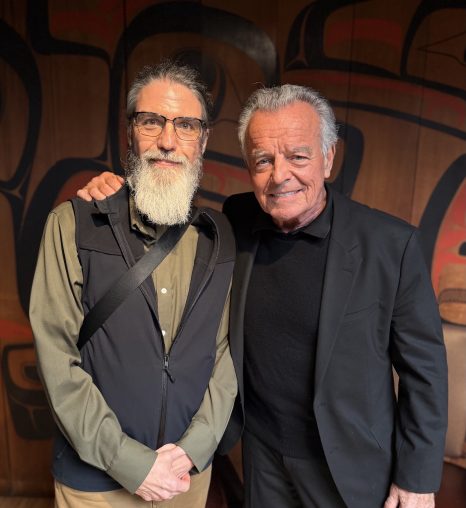
Image: Michael with Twin Peaks actor Ray Wise, October 2025

Thank you for sharing this! It’s very informative! Also very cool that you met Ray Wise. I’m working my way through Twin Peaks very slowly, great show!
@psalazar thank you for watching the recording. I think the questions were very good and hope many more students check it out.
I also have a photo with Shery Lee at the big log on the beach, where they filmed Laura‘s body being discovered.
That’s so cool!!